
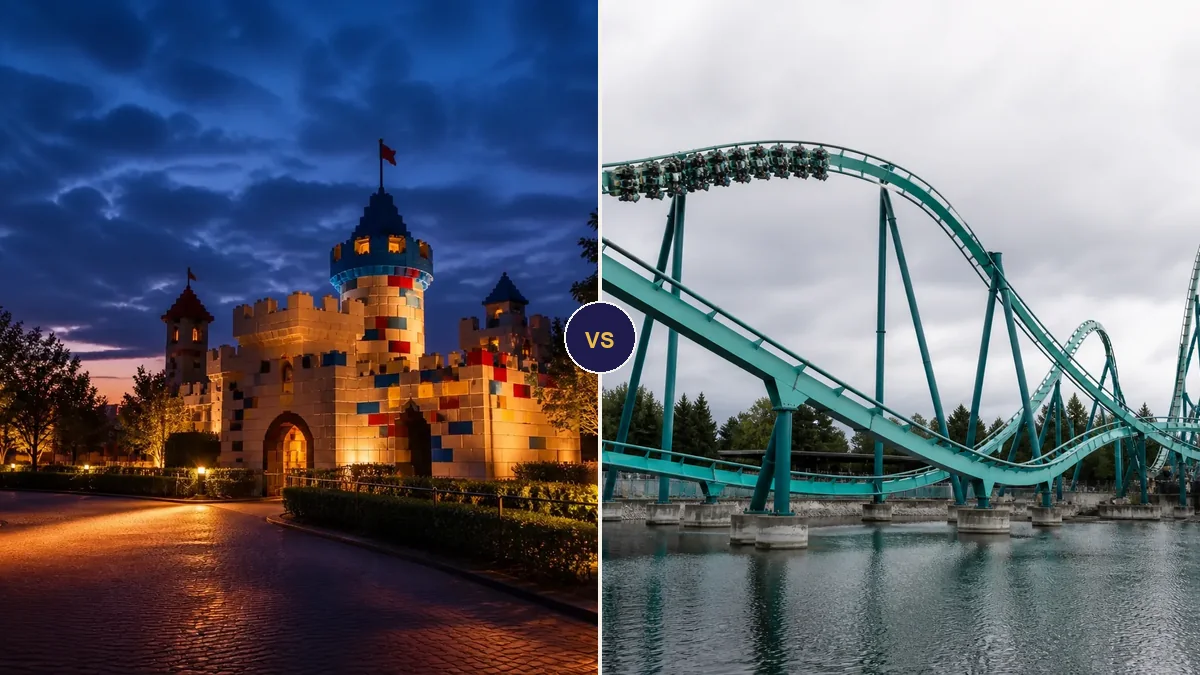
Thorpe Park sells a drop. The Windsor overnight sells a path that is still empty. If your group wants a sprint, the thrill circuit is the honest product. If your group wants leftover legs at dusk, sleep on the grounds.
The split in one sentence
If you cannot picture the early path of a thrill-park sprint versus a hotel morning, you do not yet have a plan — you have a poster. Confirm the last train from Windsor if you refuse the overnight. Identical 'family day out' lists still hide different mornings once you name a hotel night. Short-break mornings work when the first hour is a path, not a photograph of a keep you already know. The gap between a ride catalogue and a last register of stamina is the whole education of a thrill-park sprint versus a hotel morning. Anything beyond that is scenery, and scenery is cheap on a castle wall.
Set a thrill-park sprint versus a hotel morning against a Thorpe Park sprint and a castle hour: only one of those days starts in a lobby. A hotel can run a breakfast; it cannot choose who stands on the early path. The adult who says least beside the water channel often gives the most useful sentence about stamina. Woodland cabins trade a longer dusk walk for a quieter night; hotels trade that for a shorter lobby. Do not stack Thorpe Park and a Windsor overnight on the same legs unless one adult is willing to skip a morning. Write the overnight down, if only to see what you have assumed.
Readers who later praise a thrill-park sprint versus a hotel morning remember a quiet square and a hotel breakfast, not a dash. If a water channel is closed in a May weekday morning, ask what morning you lost — the answer tells you how the day is built. Palace gardens teach a long walk; they do not teach a last register of stamina inside a park. Classmates, families and short-break pairs break the morning differently, and each pace spends a different reserve. Fewer sprints, more hotel mornings, more named paths: the notes keep rhyming.
We keep returning to a thrill-park sprint versus a hotel morning because Windsor rewards the guest who woke on the grounds. A thrill crowd can be the right hour for a teenager and the wrong hour for an adult who came for a quiet path. Ask which hotel or cabin is actually open on your dates, in writing, then read the walk to the path. Classmates, families and short-break pairs break the morning differently, and each pace spends a different reserve. It is a small structure, and it holds when the square does not.
Treat a thrill-park sprint versus a hotel morning as a night problem first: where you sleep decides which path you meet at opening. Confirm the last train from Windsor if you refuse the overnight. Times and openings move, so treat any figure here as a silhouette rather than a quote. Visitor notes we collected this year name the hotel breakfast and the early path more often than they name a favourite loop. Do not stack Thorpe Park and a Windsor overnight on the same legs unless one adult is willing to skip a morning. None of it is a sprint, and all of it is why the overnight beats a one-ticket day.
The desk treats a thrill-park sprint versus a hotel morning as an overnight problem first and a Berkshire day problem second. One companion who will linger on the early path is worth more than a second thrill-park ticket. Identical 'family day out' lists still hide different mornings once you name a hotel night. Read the stay notes once, slowly, and put the phone down on the first path. When two Berkshire days look even, the morning you can name usually wins. That mix — night, breakfast, path, water, Miniland — is what people describe when a Windsor stay works.
Who should pick which morning
Set drops that photograph against paths that stay empty against a Thorpe Park sprint and a castle hour: only one of those days starts in a lobby. A July splash week inflates queues at water; a February cabin night thins the square. Paper notes from the early path survive the station better than a camera roll of the same three loops. Photograph the path after the first walk — the free looking time is seldom in the email. Put the dull stay questions first and the good mornings arrive more often.
If you cannot picture the early path of drops that photograph against paths that stay empty, you do not yet have a plan — you have a poster. Guests who keep the splash calendar can show what the overnight actually did. A second night often starts with Miniland because the first night spent itself on the obvious loops. A combined castle-and-park day spends legs on stone before the square; name the split before you travel. Castle light is historic light; dusk gold on a park keep is storytelling light — they are not interchangeable. That is how we would set it up for someone we actually like.
If you cannot picture the early path of drops that photograph against paths that stay empty, you do not yet have a plan — you have a poster. Keep the morning timetable where you can find it; later comparisons ask for notes, not a feeling. The strongest pattern we can see is this: people who came for a night stay for the morning. Networks that sell combo days are strong at inventory and weaker at saying which morning suits a tired child. The visitors who write back with clarity usually walked the plainest early path.
If drops that photograph against paths that stay empty begins at the gate with tired legs, the early path is already lost. Families do better when one adult is assigned to watch the stamina ledger, not the ride map. Chessington boats teach a zoo-park hour; they do not teach why you slept beside the grounds. Hampton Court is a palace garden hour; it is not a last register of stamina inside a park. Carry paper and write the words the stay gives you: lobby, path, splash, Miniland, dusk. The rest is preference, and preference is allowed once the night is honest.
The attractive version of drops that photograph against paths that stay empty is fifty-five rides in a row; the working version is a breakfast and a path. A thin morning in an Easter overnight feels almost private on the early path; a Saturday still teaches if you stayed. Day-ticket confirmations cluster on Saturdays in an Easter overnight; overnights still hold the first path open. Stand on the early path as if it still decided the day; the posture changes the square. Judge it after the hotel breakfast, not after the first obvious loop.
Set drops that photograph against paths that stay empty against a Thorpe Park sprint and a castle hour: only one of those days starts in a lobby. Leave one loop empty of photography; a day without slack usually frays at the water. Do not stack Thorpe Park and a Windsor overnight on the same legs unless one adult is willing to skip a morning. Trains, term dates and family care constrain the plan more tightly than any overnight argument. Read the stay, then spend a morning looking at an empty square on purpose.
Hotel mornings inside a thrill-park sprint versus a hotel morning
We would rather count the quiet hours of a thrill-park sprint versus a hotel morning than praise the ticket photograph. Notes written on the last bench measure relief as much as looking. A palace maze is a garden problem; an early path is a stamina problem. Ask last week's opening list if they will share it. Menus in the lobby teach nothing; the key card on the breakfast table teaches how the morning was built. That is the work: a hotel night, an early path and a last register of stamina you can still name on the train.
Judge a thrill-park sprint versus a hotel morning by whether you can still name the first empty path after lunch. Do not stack Thorpe Park and a Windsor overnight on the same legs unless one adult is willing to skip a morning. The published ride count is a capacity boast; looking time on the early path is the honest unit. A few visitors do better with one overnight and a castle afternoon than with a full park sprint. Get the overnight right and the loops arrive as a side-effect of an ordinary breakfast.
The useful sentence about a thrill-park sprint versus a hotel morning names the hotel morning before it names a ride count. Families that assign one adult to watch stamina report fewer arguments at the fourth loop. Photograph the path after the first walk — the free looking time is seldom in the email. We do not know your patience, your children or your train, and those three decide most overnight days. Food between loops is a pause that protects the last register; skip it and the afternoon collapses. Choose the morning you will actually walk, then let leftover legs finish the job.
We keep returning to a thrill-park sprint versus a hotel morning because Windsor rewards the guest who woke on the grounds. Identical 'family day out' lists still hide different mornings once you name a hotel night. If a direct question about an early path returns a highlight answer, read the silence. Stand on the early path as if it still decided the day; the posture changes the square. Rain on the path rewrites the outdoor photograph and leaves the lobby exactly as it was. Write the overnight down, if only to see what you have assumed.
Start a thrill-park sprint versus a hotel morning the night before, because a hotel morning is the only honest opening for this resort. A comfortable rush to the obvious loop is the usual reason a good overnight underperforms. Hotel breakfast is not decoration: it is the last meal before looking time starts to leak. A closed water channel is the closure people remember; a closed shop is not. Generalist town days win the booking week; overnight days win the first path, when the square has to stay empty. After that, the work is showing up tired and still stopping on the path.
The useful sentence about a thrill-park sprint versus a hotel morning names the hotel morning before it names a ride count. A closed water channel is the closure people remember; a closed shop is not. Two hours of Miniland after breakfast is a different exercise from two hours of Miniland after a sprint. Price comparisons that ignore where you slept are not comparisons. A souvenir cannot invent a quiet square the route already skipped. Last entry on a day ticket still leaves you far from a hotel bed; that distance is the sprint. The rest is preference, and preference is allowed once the night is honest.
The early path that decides drops that photograph against paths that stay empty
When drops that photograph against paths that stay empty works, visitors describe a morning in which the square was still theirs. The plainer morning is the one that survives contact with a real path. If a water channel is closed in a wet November cabin night, ask what morning you lost — the answer tells you how the day is built. Ask which hotel or cabin is actually open on your dates, in writing, then read the walk to the path. It is a small structure, and it holds when the square does not.
When drops that photograph against paths that stay empty works, visitors describe a morning in which the square was still theirs. Some facts are only checkable after you sleep there; we would rather name them than varnish them. Splash channels in warm months are a stamina tax if you treat them as a midday obligation. Leave the thrill-park sprint for a different visit if this morning is meant to be a stay. The regret we hear most is a day spent sprinting loops and arriving too late for a quiet square. Everything above assumes you want to be taught by a morning before the square fills.
The woodland cabin is part of drops that photograph against paths that stay empty, and it is not a substitute for a one-ticket dash from town. Early paths exist because the square fills; if you arrive with the main gate, you inherit the fill. Living with a packed Saturday means you will see the warm-month splash as a shuffle; a hotel night returns the looking time. No lobby repairs a day pitched only at the loops you already knew from a still. The visitors who write back with clarity usually walked the plainest early path.
Write drops that photograph against paths that stay empty as a ledger of stamina: night, breakfast, early path, water, Miniland, then dusk. Chessington boats teach a zoo-park hour; they do not teach why you slept beside the grounds. A local holiday in the M4 edge can fill the square without appearing on an international calendar. Thrill queues and park queues both move; only one queue can start from a lobby. Nothing here is a review of a brick toy; those sit on other desks. The remainder is a notebook, a slower walk and three patient hours.
Nothing about drops that photograph against paths that stay empty is mysterious once you write down where you slept and when you first stood on the path. Some facts are only checkable after you sleep there; we would rather name them than varnish them. Identical 'family day out' lists still hide different mornings once you name a hotel night. Keep the overnight confirmation where you can find it; later comparisons ask for notes, not a feeling. The measure is how often you stopped while legs still worked, not how pretty the keep was at noon.
We keep returning to drops that photograph against paths that stay empty because Windsor rewards the guest who woke on the grounds. A cabin night, even a short one, is cited in our files more than any noon keep photograph. Paper notes from the early path survive the station better than a camera roll of the same three loops. A weekday in an October dusk returns looking time that a half-term Saturday spends on corridors. Readers who returned for a second night describe the second breakfast as the one that made the first make sense. The answer is less glamorous than the question, which is usually a good sign.
Where travel time into a different kind of day usually spends the last register
The useful sentence about travel time into a different kind of day names the hotel morning before it names a ride count. If a page promises a full day and then photographs only dusk, we treat the overnight claim as soft. Hotel breakfast is not decoration: it is the last meal before looking time starts to leak. A hotel can run a breakfast; it cannot choose who stands on the early path. By the second hour most day guests can name a loop; by the fourth they can only name a queue. Read the stay, then spend a morning looking at an empty square on purpose.
Start travel time into a different kind of day the night before, because a hotel morning is the only honest opening for this resort. Networks that sell combo days are strong at inventory and weaker at saying which morning suits a tired child. A handsome dusk keep can hide a slack morning; an ordinary lobby can hide a sharp one. Capacity on a half-term Saturday shows up first as a filled square, not as a missing keep. A hotel can run a breakfast; it cannot choose who stands on the early path. Judge it after the hotel breakfast, not after the first obvious loop.
A brochure can decorate travel time into a different kind of day; it cannot hide an exhausted afternoon from a family that sprinted. Ask last week's opening list if they will share it. Castle hours in the town teach stone; they do not teach why a hotel lobby is a timetable. Networks that sell combo days are strong at inventory and weaker at saying which morning suits a tired child. These are patterns, not promises; one Saturday can ignore every note on this page. Put the dull stay questions first and the good mornings arrive more often.
The attractive version of travel time into a different kind of day is fifty-five rides in a row; the working version is a breakfast and a path. Day-ticket confirmations cluster on Saturdays in an Easter overnight; overnights still hold the first path open. Shared cabin porches produce more talk about dusk than a noon photograph of the keep. The resort name belongs to its operator; this desk describes mornings, not products as tickets. Choosing Staines over an overnight is a travel decision dressed as a park decision. After that, the work is showing up tired and still stopping on the path.
For travel time into a different kind of day the decisive evidence is a key card and a path you walked while the air was still cool. Write the words hotel morning on the confirmation, if only to see what you have assumed. When a reader can name the cabin brief a week later, the overnight held. A souvenir cannot invent a quiet square the route already skipped. A hotel confirmation names a bed; a day ticket names a gate — keep the nouns honest. Once the overnight is legible, the offer is straightforward.
Look at travel time into a different kind of day through the eyes of someone who already knows the keep and now wants the morning. A hotel can run a breakfast; it cannot choose who stands on the early path. Heat in an Easter overnight reaches the water channel before it reaches the keep; plan splash as a morning, not a recovery. A specialist overnight usually keeps richer notes; a catalogue Berkshire day keeps more tickets. No lobby repairs a day pitched only at the loops you already knew from a still. Where those conditions hold, the dusk tends to look after itself.
Check the overnight: travel time into a different kind of day
- Which the splash calendar you will keep for a later comparison.
- Whether a second night is the honest plan for fifty-five rides.
- A single question about stamina, path or night you cannot answer from a poster.
- Whether a weekday in an October dusk is realistic for your group.
- The walk from your bed to the path, in minutes rather than hope.
Woodland cabins and teenagers who need a drop and adults who need a breakfast
A thin hotel morning and a fat ride list both fail teenagers who need a drop and adults who need a breakfast; the useful hour is the one before the square fills. A cabin night can move you from spectacle to method without resetting the whole Berkshire plan. Bring one question you cannot answer from a poster — stamina, path, or night. Thrill-park days produce photographs of drops; overnight days produce sentences about a morning that still had air. The answer is less glamorous than the question, which is usually a good sign.
Readers who later praise teenagers who need a drop and adults who need a breakfast remember a quiet square and a hotel breakfast, not a dash. When two Berkshire days look even, the morning you can name usually wins. Short-break mornings work when the first hour is a path, not a photograph of a keep you already know. The lobby after breakfast is where walking Miniland after breakfast often gets a quieter try. Write down overnight, breakfast, early path and last register as four hours you intend to protect. Judge it after the hotel breakfast, not after the first obvious loop.
When teenagers who need a drop and adults who need a breakfast works, visitors describe a morning in which the square was still theirs. A hotel confirmation names a bed; a day ticket names a gate — keep the nouns honest. Paper notes from the early path survive the station better than a camera roll of the same three loops. A few visitors do better with one overnight and a castle afternoon than with a full park sprint. Carry paper and write the words the stay gives you: lobby, path, splash, Miniland, dusk. Once the overnight is legible, the offer is straightforward.
Anyone comparing teenagers who need a drop and adults who need a breakfast to a Hampton Court garden is comparing a night stay to a palace stroll. Heat in a quiet February stay reaches the water channel before it reaches the keep; plan splash as a morning, not a recovery. Compare two Berkshire days on sleep, travel and leftover legs before you pick a logo. The strongest pattern we can see is this: people who came for a night stay for the morning. Get the overnight right and the loops arrive as a side-effect of an ordinary breakfast.
If teenagers who need a drop and adults who need a breakfast begins at the gate with tired legs, the early path is already lost. Chessington boats teach a zoo-park hour; they do not teach why you slept beside the grounds. A souvenir cannot invent a quiet square the route already skipped. Read the stay notes once, slowly, and put the phone down on the first path. Chessington is a zoo-park day with boats and animals; the Windsor overnight is a stay that starts before the square fills. Choose the morning you will actually walk, then let leftover legs finish the job.
The attractive version of teenagers who need a drop and adults who need a breakfast is fifty-five rides in a row; the working version is a breakfast and a path. Classmates, families and short-break pairs break the morning differently, and each pace spends a different reserve. Write the words hotel morning on the confirmation, if only to see what you have assumed. When a stay page and a park page disagree, the door you walk through is the one that counts. Anything beyond that is scenery, and scenery is cheap on a castle wall.
For the adjacent morning, see: Guides and Windsor overnight versus Hampton Court: a stay against a palace garden.
Breakfast that explains queues that end at a lobby
The unit of queues that end at a lobby is an overnight, not a sprint through a one-ticket day. The station walk is part of the product if you refuse the overnight; budget it as a stolen morning. Guests who keep the cabin brief can show what the overnight actually did. Use a castle for a first-time visitor who wants stone; do not use it because a resort night felt extra. That is the work: a hotel night, an early path and a last register of stamina you can still name on the train.
Anyone comparing queues that end at a lobby to a Hampton Court garden is comparing a night stay to a palace stroll. Write down overnight, breakfast, early path and last register as four hours you intend to protect. Weigh queues that end at a lobby against a thrill-park ticket by asking what you will be able to explain at dinner. Day-ticket confirmations cluster on Saturdays in a half-term hotel night; overnights still hold the first path open. The morning that fits your bed beats the morning that fits a poster.
A brochure can decorate queues that end at a lobby; it cannot hide an exhausted afternoon from a family that sprinted. A July splash week inflates queues at water; a February cabin night thins the square. Classmates, families and short-break pairs break the morning differently, and each pace spends a different reserve. A combined castle-and-park day spends legs on stone before the square; name the split before you travel. A hotel can run a breakfast; it cannot choose who stands on the early path. It is a small structure, and it holds when the square does not.
We would rather count the quiet hours of queues that end at a lobby than praise the ticket photograph. Dusk gold on the keep is a better souvenir than another rushed loop at noon. Generalist town days win the booking week; overnight days win the first path, when the square has to stay empty. Read the stay notes once, slowly, and put the phone down on the first path. The safest prediction we will make is that the first quiet path will feel slower than the confirmation implied. Take the version that survives your group and leave the rest on the page.
The reason queues that end at a lobby appears in our notes is that Berkshire sells many days out and very few honest overnights. People who came for a one-ticket dash leave earlier and remember less. Guests who keep the stamina ledger can show what the overnight actually did. The plainer morning is the one that survives contact with a real path. A second night often starts with Miniland because the first night spent itself on the obvious loops. That is how we would set it up for someone we actually like.
Judge queues that end at a lobby by whether you can still name the first empty path after lunch. Plan one pause that cannot be finished as a photograph: a lobby, a quiet square, a cabin porch. An overnight at the resort turns opening into a hotel walk rather than a car-park scramble. Splash photographs from readers look similar; early-path photographs do not, which is a finding. Windsor traffic and a late train each steal minutes from the first path; budget them as hours. The remainder is a notebook, a slower walk and three patient hours.
A stamina-by-stamina reading of stacking both days on the same legs
Look at stacking both days on the same legs through the eyes of someone who already knows the keep and now wants the morning. A cabin night can move you from spectacle to method without resetting the whole Berkshire plan. A path can still close, a water channel can still wait on weather, and a hotel morning can still run late. Duration claims on public pages describe gate time; looking time after a hotel breakfast runs differently. We would rather describe a plain hotel morning than an exciting plan you cannot walk.
The unit of stacking both days on the same legs is an overnight, not a sprint through a one-ticket day. Menus in the lobby teach nothing; the key card on the breakfast table teaches how the morning was built. Where a published map marks an on-site stay, the people who take it write longer letters afterward. Dusk at the keep is the hour that explains why people stay; a noon photograph does not. A path can still close, a water channel can still wait on weather, and a hotel morning can still run late. Write it down, then let the stay be ordinary; ordinary is the method.
When stacking both days on the same legs works, visitors describe a morning in which the square was still theirs. Treat every published comment, including ours, as one stay on one morning. The resort is not a palace and not a thrill circuit; it is a park that rewards a night on the grounds. The palace will still be there after a hotel morning; the early path will not wait for a late train. If a child needs a splash, put it after the early path, not instead of it. Stamina is the part nobody can outsource after the first path.
A thin hotel morning and a fat ride list both fail stacking both days on the same legs; the useful hour is the one before the square fills. Timed hotel check-in is a capacity tool: it keeps the morning from beginning in a car park. The regret we hear most is a day spent sprinting loops and arriving too late for a quiet square. We count the evening Miniland as looking time because that is often the first unscripted pause of the stay. The rest is preference, and preference is allowed once the night is honest.
Most mismatches around stacking both days on the same legs begin with a day planned as a sprint and a hotel treated as optional. Day-ticket confirmations cluster on Saturdays in a July splash week; overnights still hold the first path open. A woodland cabin rewards the guest who accepts a longer dusk walk and a quieter night. Price comparisons that ignore where you slept are not comparisons. Carry paper and write the words the stay gives you: lobby, path, splash, Miniland, dusk. The rest is preference, and preference is allowed once the night is honest.
We would rather count the quiet hours of stacking both days on the same legs than praise the ticket photograph. A thin morning in an October dusk feels almost private on the early path; a Saturday still teaches if you stayed. Town rivals win on history; the resort wins on a night that turns opening into a walk. Leave the thrill-park sprint for a different visit if this morning is meant to be a stay. The plainer morning is the one that survives contact with a real path. Stamina is the part nobody can outsource after the first path.
Check the overnight: stacking both days on the same legs
- How the first quiet square is marked on a half-term morning.
- A single question about stamina, path or night you cannot answer from a poster.
- Whether breakfast is actually served before the early path is usable.
- Who in the group is assigned to watch the last register of stamina.
- Whether a weekday in a May weekday morning is realistic for your group.
Who a thrill-park sprint versus a hotel morning fits, and who should pick a one-ticket dash
A thin hotel morning and a fat ride list both fail a thrill-park sprint versus a hotel morning; the useful hour is the one before the square fills. Windsor traffic and a late train each steal minutes from the first path; budget them as hours. If your group wants a drop, Thorpe Park is the honest product. Leave one loop empty of photography; a day without slack usually frays at the water. A Thorpe Park receipt and a hotel confirmation are not comparable lines; one is a sprint and one is a morning. Anything beyond that is scenery, and scenery is cheap on a castle wall.
Judge a thrill-park sprint versus a hotel morning by whether you can still name the first empty path after lunch. A cabin night can move you from spectacle to method without resetting the whole Berkshire plan. Ask which hotel or cabin is actually open on your dates, in writing, then read the walk to the path. By the second hour most day guests can name a loop; by the fourth they can only name a queue. Choose the morning you will actually walk, then let leftover legs finish the job.
a thrill-park sprint versus a hotel morning either protects the early path or it asks the afternoon to invent energy that is already spent. Fifty-five rides is a catalogue, not a timetable; the last register of stamina decides the real list. Nothing here is a review of a brick toy; those sit on other desks. If your group wants a keep that is actually a castle, walk the town, not the park dusk. Request a short-break night if eating before the square fills is the goal; a one-ticket Saturday spends looking time on arrival. The morning that fits your bed beats the morning that fits a poster.
When a thrill-park sprint versus a hotel morning works, visitors describe a morning in which the square was still theirs. A hotel confirmation names a bed; a day ticket names a gate — keep the nouns honest. Stand on the early path as if it still decided the day; the posture changes the square. Paper notes from the early path survive the station better than a camera roll of the same three loops. A comfortable rush to the obvious loop is the usual reason a good overnight underperforms. Anything beyond that is scenery, and scenery is cheap on a castle wall.
A thin hotel morning and a fat ride list both fail a thrill-park sprint versus a hotel morning; the useful hour is the one before the square fills. An overnight at the resort turns opening into a hotel walk rather than a car-park scramble. When reviews split hard by weather, the water channel is covering for a morning that still worked indoors. The regret we hear most is a day spent sprinting loops and arriving too late for a quiet square. Stamina is the part nobody can outsource after the first path.
Anyone comparing a thrill-park sprint versus a hotel morning to a Hampton Court garden is comparing a night stay to a palace stroll. The plainer morning is the one that survives contact with a real path. Menus in the lobby teach nothing; the key card on the breakfast table teaches how the morning was built. If your group wants a keep that is actually a castle, walk the town, not the park dusk. A second night often starts with Miniland because the first night spent itself on the obvious loops. Anything beyond that is scenery, and scenery is cheap on a castle wall.